From: The MGA With An Attitude
SPECIAL NOTES ON WIPER MOTOR WIRING - ET-110
To avoid malfunction and blown fuses the wiper motor must be
properly connected. Given 6 ways to connect 3 individual wires, 5 ways will
malfunction and 4 ways will blow a fuse.
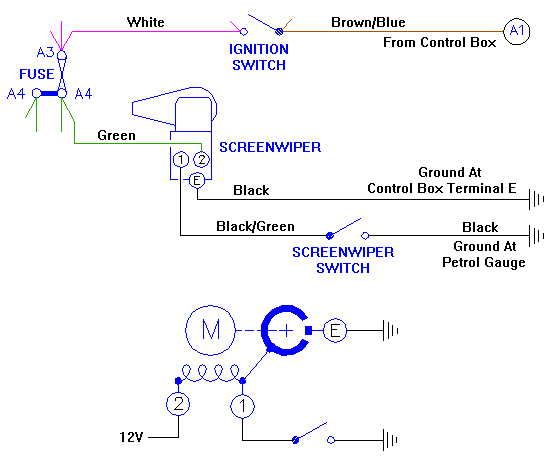
The lower diagram here is a schematic of the wiper circuit
showing the internals of the motor in simple form. The coil between the 1 and
2 terminals represents the internal windings of the parallel wound motor (the
armature is in parallel with the field coil, so both will see the full 12 volt
supply). The split ring between the 1 and E terminals represents the parking
comutator that is inside the gear case and is mechanically driven by the motor.
When the motor is in any position other than parked, there is an electrical
contact made between 1 and E. When the motor is in the parked position that
contact is broken. Pulling the dash switch to the on (closed) position makes
the motor run continuously. Pushing the switch to the off (open) position allows
the motor to run until the park commutator breaks the ground circuit to stop the
motor.
Results of swapping two wires:
a.) With ground on 1 and switch on E, the motor will run continuously regardless
of the condition of the switch.
b.) With ground on 2 and power on E, it will not start if in the park position
and with the switch off. Otherwise it will run to the park position with the
switch off, and with the switch on it will blow the fuse in any position other
than parked. In fact, if there is any alternate ground path to the body, such
as through a wheelbox, then it would blow the fuse immediately regardless of
the condition of the switch or the position of the motor.
c.) With power on 1 and switch on 2, it will stay parked as long as the switch
is off. When the switch is turned on it will run just enough to make a contact
in the park commutator, and then it will immediately blow the fuse.
Results of mixing three wires:
a.) With ground on 1, the switch on 2, and power on E, It would it would not run
if in the parked position. In any position other than parked it would
immediately blow the fuse. And if there is any alternate ground path to the
body, such as through a wheelbox, then it would blow the fuse immediately
regardless of the condition of the switch or the position of the motor.
b.) With ground on 2, the switch on E , and power on 1, it would start
immediately and run continuously (if the switch was off). If the switch is on
it would blow the fuse and as soon as it left the parked position. And if there
is any alternate ground path to the body, such as through a wheelbox, then it
would blow the fuse immediately after leaving the park position, regardless of
the condition of the switch.
As none of the above are good alternatives to the proper connection, let's try
to get it right the first time.
|